
Home » Self help resources » Behavioural strategies for anxiety
Anxiety scaling
In session I often talk about anxiety scaling: Rating the intensity of your anxiety on a numbered scale from one to ten. A score of 10 is generally reserved for panic attacks, but besides that the scale is completely subjective, meaning it’s different for everyone. It’s just a strategy to keep track of your experience in any given moment, and to help increase your emotional awareness.
It’s also handy as a warning system. When you notice your symptoms of anxiety are increasing, it can be helpful to have a set point at which you can acknowledge it’s time to do something to prevent your score getting any higher.
An example rating scale is below. Keep in mind that descriptions, symptoms and sensations differ individually, so some may not apply, or the progression may look quite different. There can also be differences for an individual across different days, depending on any number of factors.
Example anxiety scale
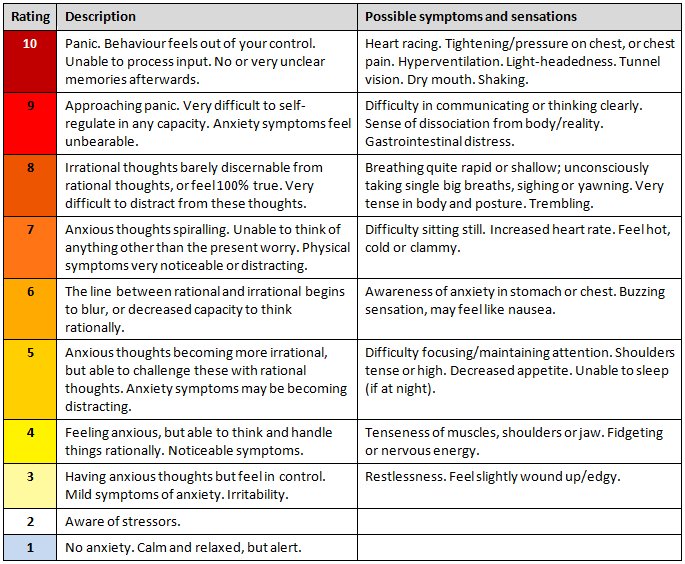
On this scale I would recommend that the set point for behavioural intervention be at a 5.
So, you’re going about your day and you notice you’ve been caught up in anxious thoughts for a while. Check in with your body and take note of your feelings, sensations and symptoms in that moment, and rate them on the scale. If you’re at, say, a 4, you might be able to manage your anxiety with cognitive strategies (challenging irrational thoughts) and follow that up with redirection or distraction.
If you’re at a 5 these strategies are less likely to be effective, because the anxiety is getting more distracting, uncomfortable and pervasive. In that case, it would be helpful to try some behavioural strategies first.
Behavioural strategies are things you can do with your body to activate your parasympathetic nervous system; in other words, to calm down and relax a bit. The idea is to bring your anxiety score down to a point at which those cognitive and/or redirection strategies will be effective, and also to interrupt the anxiety process before it gets any higher on the scale.
Which behavioural strategies will work for you is also a very subjective experience. I’ll list the most commonly recommended ones below. Some might work for you, some might not work at all, and some might only work some of the time or in certain circumstances.
I’ll ask you to please actively, physically give each of them a try though. It’s funny, but so many people hear about a strategy in session, or read about it online, and think, “I can already tell that isn’t going to work for me,” but when they do give it a genuine go are surprised to find it does, even if only partly. So it’s worth a go.
Breathing exercises
Shallow breathing contributes to anxiety: When people are anxious, they tend to take rapid, shallow breaths that come directly from the chest. This type of breathing, called thoracic or chest breathing, causes an imbalance in the oxygen and carbon dioxide levels in the body resulting in increased heart rate, dizziness, muscle tension, and other physical sensations. Your blood is not being properly oxygenated and this can signal a stress response that contributes to anxiety and panic attacks.
Deep breathing (also called diaphragmatic, abdominal, or belly breathing), on the other hand, stimulates the parasympathetic nervous system, responsible for counteracting the “fight-or-flight” response (acute stress response) to mentally or physically frightening situations.
Slow breathing
With any breathing exercise, the idea is to take deep, slow breaths. When we breathe unconsciously we generally take upwards of ten breaths a second, and when anxious this gets much faster. To calm anxiety, make each breath last as long as you can. Hold for a few beats before inhaling and exhaling. Exhale for longer than you inhale.
A good rule of thumb (although it can differ slightly for everyone) is 6 breaths per minute.
Some people find the 4-7-8 technique useful:
- First, empty your lungs of air.
- Breathe in quietly through the nose for a count of 4 seconds.
- Hold the breath for a count of 7 seconds.
- Exhale forcefully through the mouth for 8 seconds.
- Repeat the cycle up to 4 times.
Abdominal breathing
A quick and easy “cheat” for ensuring you are deep breathing.
- Sit or lie down comfortably.
- Place one hand on your chest and one hand down low, on your belly.
- Inhale, slowly and gently, through your nose.
- Focus your attention on your hands, and notice their movement with your chest and belly. Concentrate on filling your “belly” with air. Consciously push the air down deep into the bottom of your lungs. Your belly hand should be moving more than your chest hand.
- Exhale through your mouth, letting the air whoosh out as it will, and notice your hands move back towards your spine.
Progressive muscle relaxation
One of the sympathetic nervous system’s reactions to fear and anxiety is muscle tension. It’s part of an adaptive process that prepares the body for potentially dangerous situations; however it can result in feeling tense, can lead to muscle aches and pains, and can leave you feeling exhausted. Think about how you respond to anxiety. Do you tense up when you’re feeling anxious? Conscious muscle relaxation can be particularly helpful in cases where anxiety is especially associated to muscle tension.
General procedure
- Minimise distractions and make yourself comfortable, sitting or lying down.
- When you are ready to begin, tense the muscle group described. Make sure you can feel the tension, but not so much that you feel a great deal of pain.
- Hold the muscles tense for a count of 5 seconds.
- Slowly release the muscles and allow them to relax and go floppy.
Muscle group progression
- Start with your feet: Arch both feet down/towards the heel, and curl the toes under.
- Lower legs: Do this one slowly and carefully to avoid cramps. Curl your toes upward, towards your knees, to stretch the calf muscles.
- Upper legs: Tighten your thigh muscles.
- Hips and buttocks: Squeeze your buttock muscles.
- Chest and stomach: Breathe in deeply, expanding your chest and stomach with the air.
- Hands and forearms: Make fists with your hands.
- Upper arms: Bring your forearms up to your shoulders to tense your biceps.
- Shoulder blades and back: Push your shoulder blades back, almost trying to touch them together, so that your chest is pushed forward.
- Shoulders: Tense the muscles in your shoulders as you draw them up towards your ears.
- Neck: Being careful against straining these muscles, pull your head back slowly, looking up towards the ceiling.
- Jaw: Open your mouth as wide as you can, as you might when you’re yawning.
- Eyes and cheeks: Squeeze your eyes shut tight.
- Forehead: Raise your eyebrows as high as they’ll go.
Tapping
Emotional freedom technique (EFT), also known as tapping, is a therapeutic intervention that combines both cognitive and physical elements. By tapping on a sequence of acupressure points on the body, while focusing on an issue you wish to improve, EFT has been demonstrated to be an effective strategy to manage anxiety, depression, stress and PTSD. This technique works by bringing you into mindful contact with your uncomfortable feelings, while grounding you in your body with the behavioural sequence.
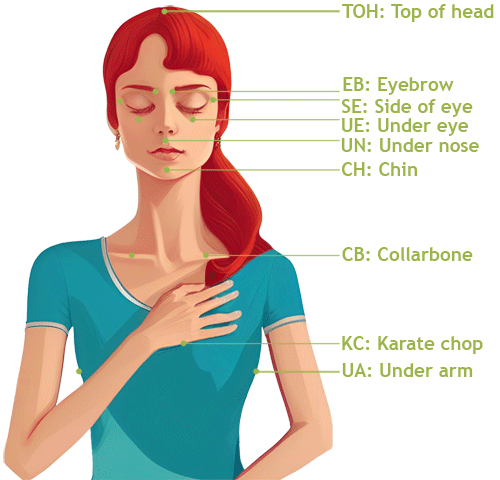
The nine main EFT tapping points include:
- Karate chop (side of hand)
- Eyebrow
- Side of eye
- Under eye
- Under nose
- Chin
- Collarbone
- Under arm
- Top of head
Basic tapping sequence
Identify the issue: In order for this technique to be effective, you must first identify the issue or fear you have. This will be your focal point while you’re tapping. Focusing on only one problem at a time is purported to enhance your outcome. (“I’m anxious about X.”)
Rate your distress level: Rate your current level of distress on a scale of 0 to 10, with zero being baseline and ten being the highest level of distress. The scale assesses the emotional or physical discomfort you feel from your focal issue. Establishing a benchmark helps you monitor your progress after performing a complete EFT sequence.
Formulate setup statement: Formulate your issue as part of a setup statement, which helps you tune into your distress. The setup statement consists of two parts. The first part acknowledges the problem you wish to address, while the second part focuses on self-acceptance. So your setup statement might be, “I feel anxious about X right now, but I profoundly and fully accept myself.”
You can alter this phrase so that it fits your problem, but it must not address someone else’s. For example, you can’t say, “Even though my mother is sick, I deeply and completely accept myself.” You have to focus on how the problem makes you feel in order to relieve the distress it causes. It’s better to address this situation by saying, “Even though I’m sad my mother is sick, I deeply and completely accept myself.”
Tapping sequence: The EFT tapping sequence is the methodic tapping on nine acupressure points of the face and body. Each point is tapped in a specific sequence about five to seven times. While tapping, repeat short phrases to maintain focus on the problem at hand. This repeated phrase is called the reminder phrase.
A sample tapping sequence for anxiety may include the following steps.
- With two or three fingers on one hand, tap the karate chop point on the other hand.
- Repeat the setup statement three times, while continuing to tap the karate chop point.
- Move through the remaining eight points on your body, tapping each one five to seven times.
- While tapping these eight points, recite a reminder phrase to maintain focus on your problem area. If your setup phrase is, “Even though I’m sad my mother is sick, I deeply and completely accept myself,” your reminder phrase can be, “The sadness I feel that my mother is sick.” Recite this phrase at each tapping point.
Repeat this sequence until resolution. Re-evaluate your distress level (give your distress a score on the 0-10 scale). Repeat the tapping sequence until your score on the scale is down to a zero or one.